Fiber Optic Attenuators
Attenuators for your fibre optic link
Attenuator modules are used to achieve a higher attenuation of a fiber-optical connection. This might become necessary under certain circumstances, i.e. on short distances to protect the optical receivers from overmodulation and damage.Unterkategorien


Fibre-optic attenuators: Precise signal control for fibre-optic networks
Fibre-optic attenuators come into play when an optical signal arrives at the receiver at too high a level. This is precisely what can become a problem over short fibre-optic distances. After all, it is not only insufficient power that disrupts stable transmission; an excessively strong signal can also overload the receiver and adversely affect the connection.
This effect can be counteracted with the appropriate attenuator. The optical power is reduced to an appropriate level so that signal transmission remains within the specified limits. For many applications in fibre-optic technology, this is a very practical component of a well-planned connection.
So, when you use fibre-optic attenuators, you are not simply reducing the signal, but ensuring the correct signal strength at the right point.
When fibre-optic attenuators are useful
In practice, it quickly becomes apparent that fibre-optic networks are not only high-performance but can also be sensitive to unsuitable signal levels. Particularly over short distances, the components used may deliver more optical power than the receiver can reasonably process. In such cases, it is not enough to simply consider the link itself; the signal strength must be actively adjusted.
This is precisely what fibre-optic attenuators are used for. They increase the attenuation within the connection and help to prevent overmodulation. This is particularly relevant in environments where stable and reproducible transmission performance is required. Anyone planning, operating or expanding fibre-optic networks should not underestimate this point.
An attenuator is therefore not merely an accessory required only in special cases. In many professional installations, it is a standard component whenever the conditions call for it.
How fibre-optic attenuators work
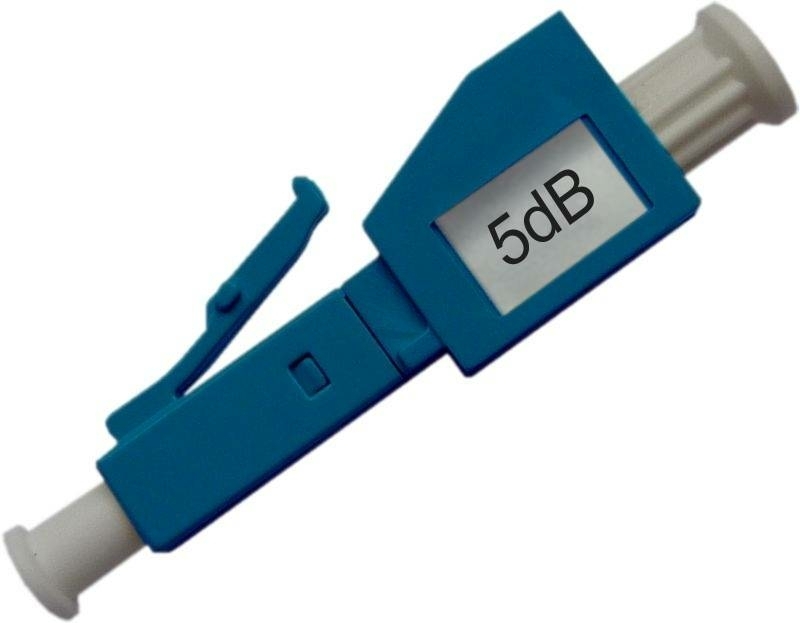
The purpose of an attenuator is to reduce the optical power within a fibre-optic link by a defined amount. This attenuates the signal before it reaches the receiver. The aim is not to degrade the link, but to bring it within a technically safe operating range.
This is particularly crucial in fibre-optic networks, where precise signal-to-noise ratios are important. Without suitable attenuation, signal problems can arise even though cables, connectors and active components are functioning perfectly. The cause is then not a fault, but simply that the optical power is too high.
Fibre-optic attenuators can be used to correct this situation precisely. This makes them a simple and effective solution for many typical applications in network practice.
Fibre-optic attenuators in professional fibre-optic networks
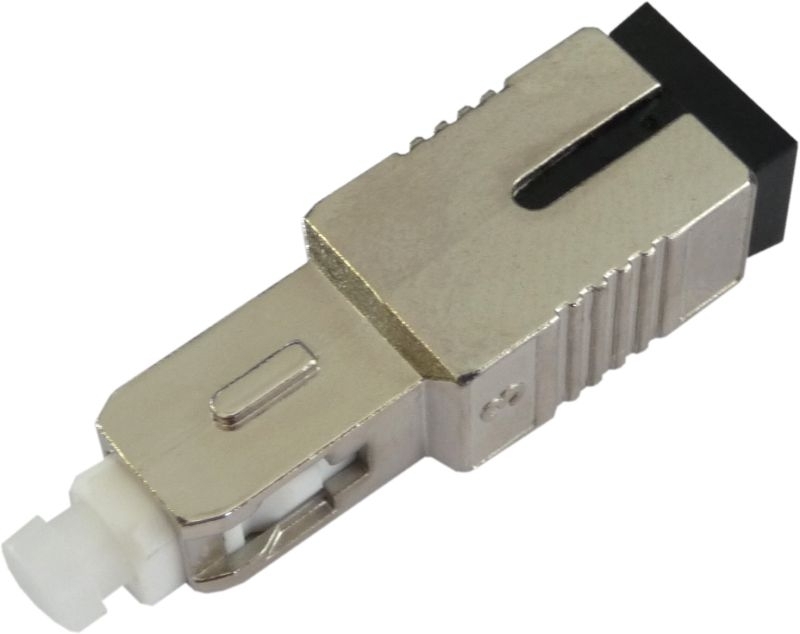
For procurement officers, project managers, electricians and IT specialists, one thing matters above all else in their day-to-day work: a solution must be technically suitable and able to integrate seamlessly into existing systems. This is precisely why fibre-optic attenuators are in such high demand in professional environments. They solve a specific problem right where it arises: with the signal strength within the connection.
In data centres, building cabling, backbone links or other fibre-optic applications, an incorrect signal level can quickly lead to unnecessary effort. Using a suitable attenuator from the outset saves time on troubleshooting and creates better conditions for stable transmission right from the start.
Particularly in the case of planned installations, it is worth considering attenuation before faults occur. In many cases, it is a technical aspect that should be taken into account from the outset.
Singlemode or Multimode: Choosing the Right Version
Not every attenuator is suitable for every fibre. That is why it is important to select the right variant for the specific application. At Fiber24, you will find suitable solutions for both singlemode and multimode environments. You should also ensure you select the correct connector type, such as LC/UPC.
For singlemode applications, singlemode 9µm variants are available. If you are working in a multimode environment, you will find suitable multimode 50µm versions in our range.
Your choice should always be compatible with your existing network infrastructure. Careful planning in this area helps to avoid unnecessary compatibility issues and ensures that the attenuator performs exactly the task for which it is intended. This involves not only the type of fibre but also selecting the appropriate connector, such as LC/UPC.
If you’d like to look up individual terms or technical concepts again, you’ll find further information on fibre-optic technology and accessories in our glossary.
What to look for when selecting fibre-optic attenuators
If you wish to purchase fibre-optic attenuators, simply looking at the product name is not enough. It is crucial that the product is suitable for the type of fibre being used and the specific application. Only then can the desired attenuation be effectively achieved in the network.
In professional environments in particular, it is vital that components function reliably and can be integrated without unnecessary rework. An attenuator should fit neatly into the existing connection and achieve precisely the effect required from a technical perspective. It is therefore worth paying attention not only to availability, but also to suitability.
Anyone who works with fibre-optic networks knows that small components can have a big impact. This is particularly true of attenuators.
Fiber24: Your partner for fibre-optic accessories
At Fiber24, we specialise in accessories and components for fibre-optic networks. As an owner-managed company, we have been active in the fibre-optic networking market since 2008 and supply customers across Europe from our base in Hamburg. Our friendly and knowledgeable sales team will be happy to help you find the right solution. From selecting individual components to finding the right equipment for your network, we’re here to support you personally and with practical advice. At the same time, we ensure fast and reliable delivery of your order.
For you, this means: a product range with a technical focus and a supplier who understands real-world requirements. This is a real advantage, particularly with products such as fibre-optic attenuators. After all, these are not just standard off-the-shelf items, but components that must function precisely within a specific network installation.
If you’d like to find out more about Fiber24, you can find further information right here under Fiber24.
Buy fibre optic attenuators online and prevent signal overload
If you wish to buy fibre optic attenuators online, you should opt for a solution that is technically suitable and has proven itself in day-to-day network operations. Fiber24 offers just the right products for a variety of fibre optic applications. Whether single-mode or multi-mode – the key is to ensure that the optical power at the far end is exactly where it should be.
A suitable attenuator helps to prevent receiver overload and ensures the connection is properly balanced. This is particularly important over short distances, where, in practice, it can quickly determine the quality of the entire transmission.
In our online shop, you’ll find fibre optic attenuators for professional fibre optic networks and applications where controlled signal levels are essential. Make sure to consider not only whether the fibre is single-mode or multi-mode, but also the correct connector type, such as LC/UPC. This allows you to ensure greater operational reliability in your infrastructure with minimal effort. With the right attenuator, you can technically optimise your fibre-optic connection to the correct level.
Frequently asked questions
Overdriving the optical receiver leads to signal distortion, loss of sensitivity and an increased error rate during data transmission. The device can no longer correctly evaluate the signal strength, leading to unstable connections and potential data loss. Furthermore, the receiver may also be damaged if the overdrive is prolonged or severe. Fibre-optic attenuators prevent this problem by reducing the power to a compatible level.
Fibre-optic attenuators are usually made from optical fibre materials that have been specially treated or modified to achieve controlled attenuation levels. Common materials include glass fibres with a specially adapted coating or embedded filter materials that specifically attenuate the light without compromising signal quality.
Singlemode attenuators are generally available with attenuation values in the range of 1 to 10 dB and are precisely optimised for a core diameter of 9 µm. Multimode attenuators, on the other hand, which are adapted to the larger core structure of 50 µm, exhibit comparable attenuation values; however, losses may vary slightly due to mode dispersion, which is why the selection should be tailored to the specific application.
Yes, fibre-optic attenuators can be easily integrated into existing fibre-optic connections, provided that the connector type and fibre type are compatible. This allows for flexible adjustment of the signal strength even after the infrastructure has been completed, without the need for major modifications.
The type of connector is crucial for the compatibility of an attenuator with the existing fibre-optic infrastructure. LC/UPC connectors, for example, ensure low reflections thanks to their polished surface, which guarantees clean signal transmission. An unsuitable connector type can cause signal loss and compromise the required attenuation.
Adherence to a defined optical power level is essential for the optimal operation of the receivers and to prevent overmodulation. Only within this operating range is signal quality guaranteed, error rates kept low, and the service life of the active components extended. Deviations can lead to unstable connections and increased maintenance requirements.